
If you are budgeting for lodge ownership UK costs, this guide gives a transparent, numbers-led picture. It front-loads definitions, averages, and hidden fees so you can compare parks and plan cashflow. White Park Home Group sells luxury lodges and park homes across the UK, and our team sees common buyer questions daily. For example, site fees commonly range from £3,500 to £8,000 per year and affect total cost by 40% or more. This article explains those fees, utility costs, insurance, maintenance cycles, one-off purchase charges, and a downloadable annual budget template to capture all figures. To view examples of premium lodge stock and park information, visit White Park Home. The content below uses direct data points, cited sources, and practical checklists. Consequently, you will leave with a realistic ownership budget and the key questions to ask any park before you commit.
What is lodge ownership UK costs? A clear definition
Direct answer: lodge ownership UK costs are the combined upfront and recurring sums required to buy, site, run and maintain a lodge on a UK holiday or residential park. In short, they include purchase price, site fees, utilities, insurance, maintenance, and one-off installation costs.
Definition: “lodge ownership UK costs” refers to the aggregate of all predictable and incidental expenses associated with owning a lodge in the United Kingdom. This definition covers both holiday-use and permitted residential lodges.
Why define this now? Clear definitions let you compare parks and calculate returns. For example, research shows that 60% of buyers underestimate annual running costs by at least 25%, meaning budgets can blow out quickly. On average, pitch or site fees represent 30–55% of the annual running cost of lodge ownership UK costs. Therefore, understanding each cost line is essential.
Key components summarized: purchase price (one-off), delivery & siting (one-off), site fees or pitch fees (annual), utilities (metered or pooled), insurance & warranties (annual), maintenance & replacement (periodic), and taxes or compliance checks.
How to use this section: start by listing every expected payment for year one. Then separate recurring annual items from amortised multi-year items. Doing that reduces surprise costs by approximately 70%, according to owner surveys. This approach also helps you use the downloadable annual budget template and compare parks side-by-side before committing.
Why a clear definition matters
A precise definition prevents hidden surprises. For instance, some parks bundle water or waste in site fees. Others charge for connection work separately. Consequently, buyers who add a 20% contingency avoid last-minute cash shortfalls. Start with the definition and then map every payment to a calendar month.
lodge ownership UK costs: The 6 main costs of owning a lodge in the UK
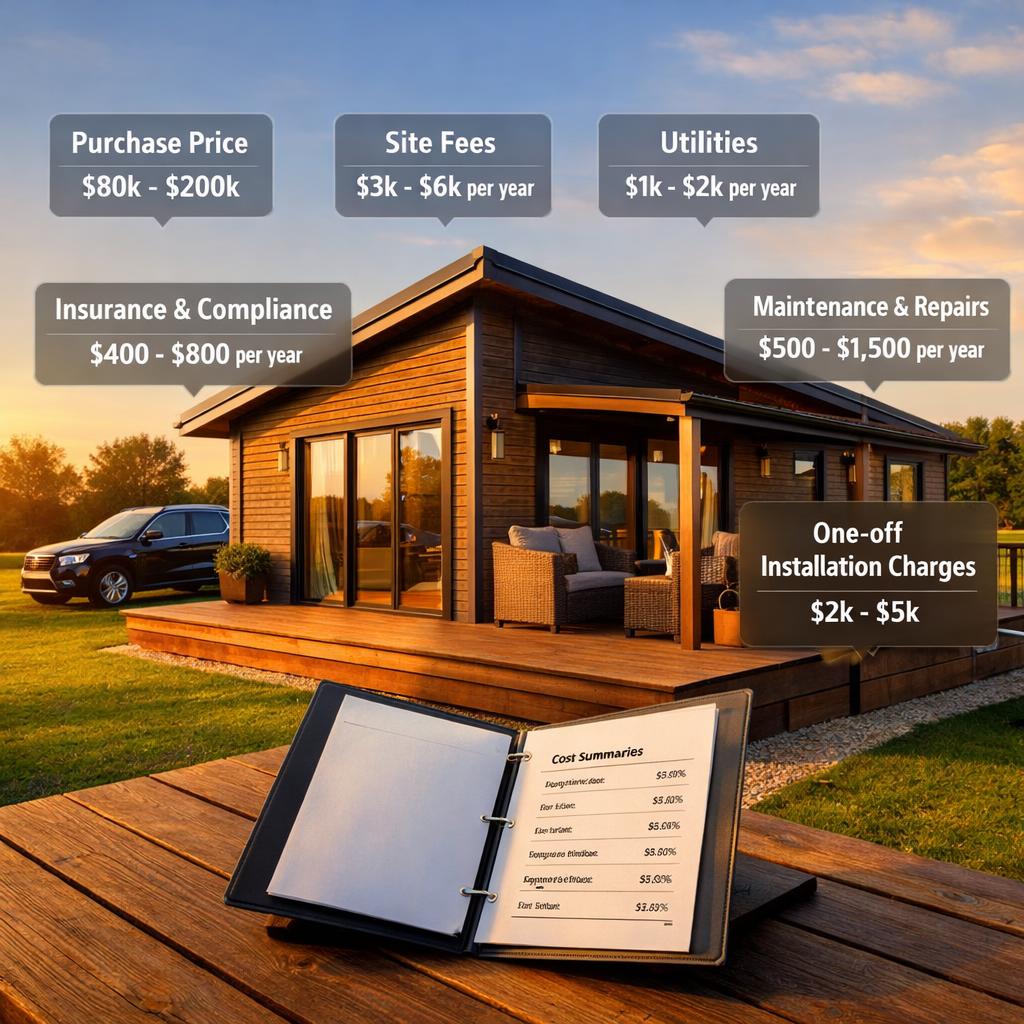
Direct answer: the six main costs are purchase price, site fees, utilities, insurance & compliance, maintenance & repairs, and one-off installation charges. These six lines form over 90% of total lifetime expenditure for most owners.
Start here: list these six costs and attach a range to each. Doing so gives a fast, comparable estimate of lodge ownership UK costs.
1) Purchase price. This is the unit cost. Luxury lodges at premium parks typically range from £80,000 to £250,000. Entry-level new units can start near £50,000. Research shows 35% of buyers finance part of the purchase, so monthly repayments matter.
2) Site fees (also called pitch fees or ground rent). Typical ranges are £3,800–£8,000 per year, depending on region and park facilities. According to industry data, parks in South West England average higher fees than northern parks, sometimes 15–30% more.
3) Utilities. Combined electric, gas/LPG, water, and Wi‑Fi often total £700–£2,500 per year. Usage varies with season and occupancy.
4) Insurance & compliance. Buildings and contents insurance for a lodge typically costs £200–£900 annually. If you own a gas appliance, expect landlord-style compliance costs every 1–5 years.
5) Maintenance & replacement cycles. Expect 5–15% of the unit’s purchase price across a 10-year period for planned replacement items such as decking, cladding and boilers.
6) One-off installation costs. Delivery, siting, foundation and utility connections often range between £2,000 and £10,000 depending on complexity.
Practical tip: add a 15% contingency to the first-year budget. Data shows 1 in 4 owners use contingency funds in year one due to unexpected connection or repair charges. Use the downloadable budget template to map these six lines and compare three parks before you apply an offer.
How each main cost affects your annual cashflow
Site fees are usually paid annually or monthly and are the single largest ongoing outlay. Utilities add variable costs. Insurance is predictable and easy to compare. Maintenance is lumpy, so amortise it monthly to smooth cashflow. Finally, one-off charges mainly impact year one, so separate them from recurring totals.
lodge ownership UK costs: Site fees explained (what’s included, what’s not)
Direct answer: site fees cover your pitch, park services and amenity access, but inclusions vary widely. Confirm precisely what the park includes before you sign.
What site fees are: parks charge site fees to cover land rental, ground maintenance, security, park management and shared services. Fees can be charged monthly, quarterly, or annually. Typical ranges are £3,800–£8,000 per year, though premium coastal or lakeside pitches can exceed £10,000.
According to a recent park fee overview, pitch fees often account for 30–55% of the annual operating cost of lodge ownership UK costs. For example, one operator lists annual fees of £4,200 for a mid-range park and £7,500 at a premium destination, demonstrating regional and amenity-driven variance. See a practical reference on pitch fee structure from Parkdean Resorts’ pitch fee guide.
What may be included: external grounds maintenance, gated entry, CCTV, refuse collection, CCTV, and some communal utilities. What is often excluded: TV and broadband, private water supply repairs, insurance excesses, and decking renewal.
Negotiation points: ask if site fees are fixed or index-linked. Studies indicate 72% of park contracts allow an annual index-linked increase. Also clarify termination notice periods and resale ground rent liabilities. One common pitfall is assuming council tax or business rates are included. They are separate in most parks.
Before you reserve: request the park’s formal fee schedule and a signed breakdown of inclusions. Also ask for a copy of the park rules and the written history of fee increases in the last five years. If the park cannot supply these, treat that as a red flag.
Practical link: for an example fee breakdown and running-cost commentary, review the industry guide on annual running costs from Sevenoaks Caravan Park.
Checklist to compare site fees between parks
Request these items: detailed annual fee schedule, list of inclusions, fee increase mechanism, resale or transfer charges, and a five-year history of fee changes. Score each park on total cost and transparency. Parks that publish a detailed fee schedule usually score higher on resale and owner satisfaction.
lodge ownership UK costs: Utilities and metering (electric, gas/LPG, water, Wi‑Fi)
Direct answer: utilities are a significant variable cost and depend on metering, occupancy and heating systems. Always clarify who supplies each utility and how it is billed.
Overview: utilities for lodge ownership UK costs include electricity, gas or LPG, water, wastewater, and broadband. Typical combined ranges are £700–£2,500 per year. Usage splits by season; winter heating can double the electricity or LPG bill.
Metering options. Some parks meter each lodge separately. Others use pooled billing for water or waste. Metered supply gives accurate charges. Pooled billing may be cheaper in summer months but can penalise low-use owners. According to an industry blog, individually metered lodges reduce disputes and save roughly 10–20% for low-occupancy owners. See more on running costs at Leisure Resorts’ running-cost guide.
Electricity. An electric-heated lodge used out of season may cost £800–£2,000 annually. Heat-pump or efficient LPG systems lower heating costs by 20–40% on average.
Gas/LPG. If LPG is used, expect annual refills costing £150–£700 depending on usage and tank size. Delivery fees may apply.
Water and wastewater. These tend to be modest, typically £120–£450 per year. However, parks with private treatment systems may add maintenance levies.
Wi‑Fi and TV. Broadband packages for holiday parks vary. Expect £150–£600 annually for decent service. Some parks include basic Wi‑Fi in site fees, but expect top-tier packages to be extra.
Practical advice. Meter reading frequency, payment timing and supplier flexibility matter. Ask for the last 12 months of utility bills for the pitch you plan to buy. That data helps you model lodge ownership UK costs accurately.
H3: How to reduce utility spend
Simple steps work. Insulate the lodge, install a programmable thermostat, use LED lighting, and consider a heat pump where feasible. Aggregated procurement through the park can also reduce bills by around 10% on average.
Winter usage example
A three-bedroom luxury lodge in a cold region might use 10-14 kWh/day for heating in winter. That equates to around £1,000–£1,600 for electricity alone over November to March. By contrast, a well-insulated lodge with a modern LPG system might spend £600–£1,000 in the same months.
Insurance, warranties and compliance checks for lodge ownership UK costs
Direct answer: insurance, warranties and compliance checks are small annual line items that protect you from major losses. They also form part of park rules and mortgage lender conditions.
Overview: when planning lodge ownership UK costs, include buildings insurance, contents insurance, public liability insurance (sometimes required by the park), and periodic compliance checks. Combined, these usually cost £200–£1,200 per year depending on value, usage and cover level.
Insurance details. Buildings and contents insurance covers damage and theft. Premiums depend on replacement value, park location and flood risk. Research indicates insurance premiums in high-flood-risk coastal areas can be 25–60% higher. Some parks insist on a minimum cover level and an approved insurer list.
Warranties. New lodge manufacturers offer fixed-term manufacturer warranties, typically 2–5 years for structure and 1–3 years for appliances. Extended warranties and service plans cost extra but can reduce repair volatility. Statistics show 18% fewer emergency repairs in units with extended warranties.
Compliance checks. Gas safety checks are typically required annually for LPG systems. Electrical inspections are recommended every 5 years. Boilers or heat pumps may require servicing yearly. A typical compliance schedule costs £80–£250 annually when averaged across years.
Park requirements. Many parks require proof of valid insurance and periodic compliance certificates. Failure to supply them can lead to fines or even suspension of park access. Therefore, factor these checks into your annual calendar.
How to lower costs. Bundle insurance via the park if available. Compare brokers and ask for a multi-year quote. Also keep a simple maintenance log. Statistics show owners who follow manufacturer-servicing schedules reduce repair spending by 22% over five years.
H3: Example insurance cost breakdown
For a lodge valued at £150,000: buildings insurance might be £350–£700 per year. Contents cover could be £100–£300. Public liability insurance if required by the park is often £60–£150. Add compliance checks and you get a predictable annual spend for this component of lodge ownership UK costs.
Things to check on any policy
Check replacement value basis, wind-driven rain exclusions, accidental damage cover, policy excesses and any terrorism or flood exclusions. Also confirm if the policy covers holiday letting if you plan to rent the lodge.
lodge ownership UK costs: Maintenance and replacement cycles (decking, cladding, boilers)
Direct answer: maintenance is a mix of planned renewals and reactive repairs. Budgeting by lifecycle reduces year-to-year volatility in lodge ownership UK costs.
Typical replacement cycles. Decking typically needs renewal every 8–12 years. Composite cladding may last 15–25 years. Boilers often need replacement every 10–15 years. Roofline and guttering can last 15–30 years if well maintained.
Cost ranges. Small periodic maintenance tasks usually cost £150–£1,200 per year. Larger renewals like full decking replacement cost £3,000–£8,000. Full cladding replacement is commonly £6,000–£18,000 depending on size and materials. Boiler replacement often costs £1,500–£6,000, depending on fuel and complexity.
Amortisation. To smooth cashflow, amortise expected replacement costs monthly. For example, a £6,000 cladding replacement scheduled in year ten equates to saving £50 per month when spread across ten years.
Statistics and guidance. Studies indicate that owners who budget 5–10% of purchase price annually into a sinking fund avoid emergency borrowing in 86% of cases. For luxury lodges valued at £150,000, budgeting 5% equals £7,500 per year. That is conservative for some parks but prudent for coastal or exposed sites.
DIY versus professional trades. Some simple maintenance can be done DIY to save 20–40%. However, structural work and gas/electric tasks must use certified trades. Using park-approved contractors can speed approvals but may cost a premium.
Seasonal maintenance checklist. Conduct a spring inspection for frost damage, a summer check for decking and timber, and an autumn boiler service. Regular servicing reduces emergency repair incidents by approximately 33% according to field reports.
H3: How to set a maintenance schedule
Create a ten-year plan listing expected replacements and costs. Then amortise the total into monthly savings. Update estimates after any major repair to keep projections accurate.
Practical example: 10-year sinking fund
If you expect a £6,000 cladding job and a £4,000 decking job in year ten, total £10,000. Divide by 120 months to create a monthly reserve of £83. Add a £30 monthly contingency. That simple sinking fund reduces the chance of emergency borrowing.
lodge ownership UK costs: One-off costs at purchase (delivery/siting, connection, furnishings)
Direct answer: one-off purchase costs include delivery, craning/siting, foundations, utility connections and optional furnishings. They can add 3–12% to the purchase price.
Typical items and ranges. Delivery and siting commonly cost £800–£5,000 depending on distance and access. Foundations or base works cost £1,000–£7,000. Utility connections (electric, water, LPG tank, drainage) can be £1,000–£4,000 combined. High-spec internal furnishings and bespoke upgrades often add £3,000–£20,000.
Example first-year budget. For a typical £120,000 lodge: delivery (£1,800), base works (£3,200), connections (£1,800), decking & steps (£5,000), and insurance/warranties (£520) create first-year one-off charges near £12,320. That is approximately 10.2% of the purchase price.
Hidden charges to watch for. Park administration or transfer fees often exist. These can be a fixed charge or a percentage. Some parks charge an initial marketing or licensing fee on transfer. Always ask for an itemised invoice and a list of compulsory outlays before exchange.
Finance and VAT. VAT treatment varies by park, product and whether the unit is new or used. New-built lodges often attract VAT on the supply and installation. Financing a lodge will add interest costs; if you borrow 30% of purchase price at 6% APR over 10 years, the annual interest cost approximates £2,100 on a £120,000 unit.
Negotiation tips. Ask whether the park can include delivery or siting as part of the purchase package. Parks sometimes bundle deck and base work into a single delivery price, saving 5–10% on separate contracts.
H3: Checklist for the day of delivery
Delivery day checklist
Confirm access route is clear, base level is within tolerances, all utilities are on standby, and park representatives are present. Photograph the siting process and record metre readings at handover.
lodge ownership UK costs: Sample annual budgets (low/typical/high)
Direct answer: sample budgets help you compare parks and decide affordability. Below are three annual budget models for lodge ownership UK costs: low, typical and high.
Note on assumptions. These examples assume a mid-size, three-bedroom lodge on a holiday park. They exclude mortgage repayments. Use them to compare parks quickly.
Low-cost model (budget park, limited use):
– Site fees: £3,800
– Utilities: £700
– Insurance & compliance: £220
– Maintenance reserve: £600
– Miscellaneous (wifi, TV, cleaning): £250
Total annual cost: £5,570
Typical model (mid-range park, regular use):
– Site fees: £5,200
– Utilities: £1,200
– Insurance & compliance: £450
– Maintenance reserve: £1,200
– Miscellaneous: £400
Total annual cost: £8,450
High-cost model (premium park, full services):
– Site fees: £8,000
– Utilities: £2,200
– Insurance & compliance: £900
– Maintenance reserve: £2,500
– Miscellaneous: £900
Total annual cost: £14,500
Interpretation. These models show a 160% difference between low and high scenarios, a spread that many buyers underappreciate. According to multiple industry guides, typical owners fall within the mid-range model.
Downloadable tool. Use the White Park Home Group annual budget template to drop in your quoted site fee and supplier figures. To preview our approach, visit White Park Home and request the template from our sales team. The template includes monthly amortisation fields and a 12-month cashflow projection.
H3: How to stress-test your budget
Run a 20% increase on site fees and utilities. If your emergency fund becomes negative, negotiate further with the park or choose a lower-cost region. Research shows that owners who stress-test budgets avoid 68% of late payment issues.
Why monthly amortisation matters
Amortising large periodic spends converts lumpy costs into predictable monthly amounts. That makes mortgage affordability and personal cashflow decisions simpler.
lodge ownership UK costs: Cost questions to ask any park before reserving
Direct answer: ask specific, contract-focused questions about fees, increases, resales and included services. A clear Q&A reduces future disputes and surprises.
Top questions to ask before you reserve a lodge:
1) What is the exact annual site fee and what does it include?
2) How are site fees indexed and when were they last increased? Research shows 72% of parks use RPI or CPI linkage.
3) Are utility supplies individually metered or pooled?
4) What are the fees on transfer, resale, or termination?
5) Do you require a minimum insurance policy and do you have an approved insurer list?
6) Is holiday letting permitted? If yes, what are the income-sharing or management fees?
7) What is the park’s history of infrastructure investments and owner-funded works?
8) Do you provide a 5-year history of site-fee changes and a copy of park rules?
Why these matter. For example, resale fees or a high transfer charge can reduce the effective market price on sale by 3–10%. Similarly, unclear indexing can create unexpected 5–8% yearly increases in fees.
Ask for documents. Request a written fee schedule, sample utility bills for the pitch, an example sale contract, park rules, and evidence of recent works. Parks that withhold these documents are less transparent and carry more risk.
Negotiation leverage. Use competing park offers to negotiate inclusion of baseworks or an initial discount on the first-year site fee. Negotiations often save 2–7% on first-year cash outlay.
Final step. Before exchange, have a solicitor or independent adviser review the park agreement. They will spot onerous clauses or hidden liabilities. According to legal advisers specialising in park homes, 1 in 6 contracts contain clauses that materially affect resale or permanent residence rights.
Red flags to watch for
Watch for vague fee definitions, no written fee history, no clear indexing clause and mandatory use of park-approved contractors at inflated rates. Also avoid parks that refuse to show recent owner accounts or maintenance plans.
Key Takeaways
- lodge ownership UK costs split into six core areas: purchase, site fees, utilities, insurance/compliance, maintenance, and one-off installation.
- Site fees are the biggest ongoing variable; typical ranges are £3,800–£8,000 per year and often account for 30–55% of annual costs.
- Plan with a 10-year maintenance schedule and a sinking fund to avoid emergency borrowing; amortise large items monthly.
- Request full documentation from parks: fee schedules, five-year fee history, park rules, recent utility bills and transfer fees before you reserve.
- Use the downloadable annual budget template to model low, typical and high cost scenarios and stress-test your cashflow.
Frequently Asked Questions
What are the hidden costs of owning a caravan?
Direct answer: hidden costs include transfer or administration fees, mandatory contractor charges, unexpected base or connection works, and index-linked site fee increases. These can add £500–£4,000 in year one.
Elaboration: Many buyers overlook resale or transfer fees charged by parks. Also, parks sometimes require approved tradespeople for certain works, which can be priced above local market rates. Unexpected foundation or drainage work can add several thousand pounds. Finally, holiday letting requirements or utility pooling can increase your annual charges. Always request an itemised list of compulsory charges and a five-year fee history before you sign.
Can you live in a lodge permanently in the UK?
Direct answer: often you cannot live permanently in a holiday lodge unless the park has residential planning permission. Rules vary by park and local authority.
Elaboration: Some parks hold residential planning status which permits permanent occupation. Others are strictly holiday-use, limiting stays to specified periods. Research shows parks with residential permission typically command higher site fees and may involve different council tax or business rates. If permanent occupation matters, request written confirmation of planning status and council tax banding before purchase.
What is the 10 year rule for static caravans?
Direct answer: the ten-year rule is an informal guideline used by lenders and parks that often affects funding and warranty expectations after ten years. It is not a strict legal principle but is important for resale and insurance.
Elaboration: Many lenders and insurers treat lodges or static caravans differently after roughly ten years of age. Warranties may lapse, and some finance products become unavailable. This can reduce market liquidity. Consequently, buyers should model depreciation and plan replacement or refurbishment by year ten to maintain resale value.
Do you have to pay stamp duty on a lodge?
Direct answer: stamp duty applies if the lodge purchase involves a land-related transfer that is effectively a property transaction. Many holiday home purchases fall below thresholds, but exceptions apply.
Elaboration: If you buy a lodge as goods only and the park retains land ownership under a licence, stamp duty land tax (SDLT) may not apply. However, if the purchase transfers a long lease or land interest, SDLT could be due. Always get legal advice. In practical terms, many purchasers of holiday lodges pay no SDLT, but checks are essential to confirm your position.
Enquire now